Emerging Architectures for Modern Data Infrastructure. This excellent essay by the a16z team summarizes emerging best practices and draw up a common vocabulary around data infrastructure. Several takeaways from the study:
Data infrastructure serves two purposes at a high level: 1) to help business leaders make better decisions through the use of data (analytic use cases) and 2) to build data intelligence into customer-facing applications, including via machine learning (operational use cases).
Two parallel ecosystems have grown up around these broad use cases. The essay mentioned there hasn’t been consensus on the two ecosystems will converge eventually.
My take for that is that most of the two ecosystems’ infrastructure will converge because there is no inherent boundary between the two use cases. For example, interactive data analysis is essential to build new ML features or inspect models’ quality. Building interpretable models are also super helpful to get business insights.
Instagram is a phenomenal product of the mobile Internet. One interesting thing from this interview is how tools and technologies made Instagram possible. In particular, two key factors enabled Instagram. 1) The popularity of mobile phones with good cameras, and 2) the availability of open-source tools and scalable AWS cloud infrastructure. The former created the mobile phone-sharing market of billions of users, and the latter made it possible for Instagram to scale to serve a massive amount of users with a small team.
Both Kevin and Mike are very excited about what is happening in the data & machine learning field. Many data infrastructures are being made accessible for the general audience, and the cost of setting up a machine learning (ML) system has reduced significantly in the past years. Open-source tools like TensorFlow and many clouds AI infrastructures affect the tech community, similar to what the AWS had influenced mobile development. As the machine learning infrastructure matures, what matters more for a company is what problem you use ML to solve and how you tailor your system to solve those problems.
Roadmap: Consumer Earthquakes. In this video series, BVP Partner Kent Bennett details what makes a consumer earthquake startup and the keys to a viable business model and long-term defensibility.
Leadership & Productivity
Establishing a Product Organization Structure | by Jens-Fabian Goetzmann. (you could switch the guest mode if you hit a paywall). In this article, the Head of Product @ 8fit Jens-Fabian Goetzmann gives many insightful tips for organizational structures that could empower people to build great products. Here are takeaways from the article:
An innovative product organization’s core building blocks should be “pizza-teams,” which are small teams that are often 5-8 people and formed by people of different functional groups. Pizza teams could be either permanent or temporary depends on the nature of the problems that need to be solved.
Each pizza team needs to be fully aligned with the organization’s direction. However, day-to-day decisions should be made autonomous instead of flowing through the management reporting chain, which slows down the feedback loops and often yields suboptimal results.
Functional managers should engage in coaching and empowering instead of telling their reports what to do. Managers must step back to create this space while stepping in to remove impediments, clarify context, and provide guidance.
Creative serendipity via Zoom. Is it possible? Or is creative… | by Bret Waters. In the post-pandemic new norm, Zoom is everything. However, many people miss the serendipitous nature of face-to-face interactions, which still couldn’t be entirely replaced in Zoom yet. This excellent article from Bret includes some useful tips about increasing the serendipity in Zoom meetings.
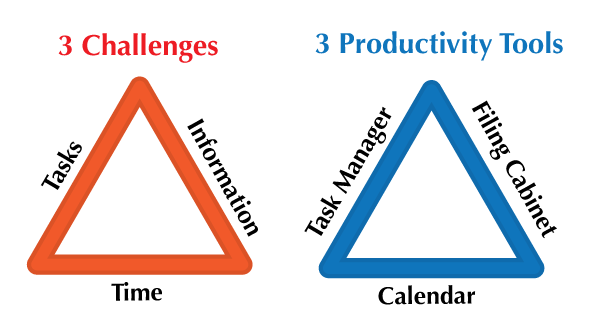
A good framework for managing your time is important for personal productivity. One interesting framework is the Tripartite Productivity System. The key is to handle three challenges: managing information, managing tasks, and managing time.
Information: We need a place to retrieve information, to process them, and to store the distilled knowledge. Generally, any document processing or note-taking software (i.e., “Filing Cabinets“) should work.
Task: This is to track the context of each task to allow attention to be focused on taking action instead of recalling contexts. There are plenty of tools for this. I personally use Trello as a personal Kanban system.
Time: We should align our day-to-day tasks to a larger picture by tracking and reviewing our time usage.
Reviewing: It is also important to do a weekly review during which you could reflect on what you have done well and what could be improved in the past week.
Remote Team
How to debug remote work, as suggested by new research. With the pandemic, a lot of startups have to operate in the full-remote mode for an extended period of time. This great article by Atlassian summarizes the ways that could improve the productivity of WFH teams. Here are several highlights from the article:
We have an opportunity to embrace the fact that hours worked (or cold-calls made, or lines of code written) was never a meaningful performance metric in the first place. Now is an ideal moment to shift our attention away from outputs of effort and focus on outcomes achieved instead.
Employee motivation is much more critical in the WFH setting. You have to make sure employees have intrinsic motivations in order for them to keep staying focused and delivering results. This is also where innovation would come.
Handle the inequality caused by working from home. Different people have different expectations of working from home. Adjust accordingly. 1) Household complexity. 2) Role complexity 3) Network quality.
WFH removes the isolation between work and life and causes a lot of extra challenges. Be mindful of the different situations employee need to face at home and make sure it doesn’t create systematic inequality.
Entrepreneurship
In this blog, the former CircleUp CEO Ryan shared his journey of creating the CircleUp and his decision to step down as CEO of the company. This is a super honest reflection with a lot of details. A good read for anyone who is curious about the startup world.
The following video is an awesome visualization of the Gartner Hype Cycle of technologies in the past 25 years. This is a great way to see how technology has evolved in the past two and a half decades
The following tweet shows the tremendous progress we have made to learn our solar system in the past three decades.
This tweet shows what a Rocket launch looks like from space. Hope that it won’t be too long before we could trip by rockets could be as normal as flights nowadays.
The current COVID-19 pandemic is not the first pandemic, and it won’t be the last one. The book The Great Influenza by John M Barry may help you envision how the future years or even decades look like. I learned this book from Bill Gates’s article in May but only finished it recently. Despite that a whole century has passed, a lot of things in this pandemic have happened in the same way as the 1918 one so the book is still very relevant.
The book is not just a chronicle, it illustrates how American society reacts to a challenge like this and provides many interesting observations. In Chapter thirty-two, the author speculates that it was influenza that caused the bad judgments of the US President Woodrow Wilson in the Paris Peace Conference and caused the even deadlier World War II. In early 1919, the representatives of all nations gathered in Paris to discuss the new world order after World War I ended in 1918 partially due to the pandemic itself. For weeks and then months, heads of the US, Britain, and France were negotiating on the terms, and the sessions often went brutal. On April 3, Woodrow Wilson suffered a health attack, which Barry thinks was influenza, and had a fever of over 103 degrees. Partially because of the deteriorated health, Wilson lost the grit and ceded the extremely harsh terms insisted by the French prime minister Clemenceau, which created chaos in Germany and caused the rise of Hitler. Wilson also agreed to Japan’s insistence that it takes over German concession in China, which triggered the May Fourth Movement in China and catalyzed the spread of communism throughout the country.
It is incredible that the aftermath of the 1918 pandemic could be felt for the whole century. Had the Wilson not cede in the Paris Peace Conference, the rest of the 20th century will be quite different. Now that the current President and many white house officials have also contracted COVID-19 recently and an election is on the horizon, there is a chance that the aftermath of this pandemic may be equally long.
Personal Improvement
This week I highly recommend this interview by Spotify Cofounder and CEO Daniel Ek. In this interview, Daniel shared his lessons on managing Spotify and his personal life.
A great meeting has three key elements: the desired outcome of the meeting is clear ahead of time; the various options are clear, ideally ahead of time; and the roles of the participants are clear at the time.
One thing I find interesting is how Daniel’s perspective on time management and meetings. According to Daniel, a meeting would be a waste of time if one or more of the elements are missing. The make-up meetings are the single largest source of optimization for a company.
“..learning resembles a tree: you see the trunk, you see the branches, and you see the leaves…“.
Another interesting thing from the interview is his comments on learning. Learning is all about the abstraction of the world. As you keep trying things, you will figure out what’s important and what’s not and build an abstract model yourself.
There are many tools to help with the process. One thing I find very useful is to organize knowledge in a graph and materialize the graph in some places (i.e. build your personal wiki). Previously I have been using Google docs to manage my notes and add cross-reference among them. Recently I started to use Notion, which I highly recommend. This video from Notion is a good tutorial for building a personal wiki using Notion.
Interesting Facts
The following tweet from Joaquim shows the first snowball fight in 1896 that happened in France. This is probably the most well-dressed snowball fight I’ve ever seen.
This cool tweet from Simon shows the trajectory of all active satellites. One interesting thing is that you could see the trains of StarLink satellites very clearly in the animation.
This week I recommend the book Behind the Cloudby the Salesforce CEO Marc Benioff. The book describes the history of Salesforce, a legendary Software-as-a-Service (SaaS) company, and summarizes Marc’s lessons on his journey.
Before Marc co-founded Salesforce, he had worked on enterprise software for many years as an Oracle executive. During the Internet boom, he took an extended leave from Oracle, spending most of the time in Hawaii and then India, to reflect his career and to think about his next venture. He came back with a belief that that software could be delivered through the Internet instead of manually installed by customers. He created Salesforce to fulfill this belief.
March Benioff used a very creative marketing strategy in the early days of Salesforce. Instead of defining Salesforce as another enterprise software company, Marc marketed Salesforce.com as a new type of company that is fundamentally different from its predecessors — a Software-as-a-Service (SaaS) company. He waved the “No Software” marketing campaign and claimed enterprise software was dead. He also organized protests during the events of his software competitors. The controversial move drew a lot of eyeballs.
His strategy was a big success. The Software-as-a-Service has become a huge market, and its market size is projected to be 307.3 Billion by 2026. There have been a lot of SaaS IPOs in 2020 so far, including Snowflake, JFrog, Sumo Logic (Please see this Crunchbase report for the full list). As the first and still largest SaaS company, Salesforce is one of the examples for companies that define new categories of markets.
Another good reading this week is Marc Andreessen On Productivity, Scheduling, Reading Habits, Work, and More. Marc Andreessen is the founder and the managing partner of the venture firm A16z. Before that, he was the founder of the legendary Netscape browser that kicked off the whole Internet revolution.
The opinions of the two Marcs, despite their wordings, are referring to the same trend. Marc Andreessen is talking that software will be more and more important. Marc Benioff is talking about how the delivery of software will shift to the cloud.
Lindy Effect refers to the fact the life of a thing is likely to be proportional to how long it has already existed. Intuitively, a thing that exists x years is likely to exist for another x years. This is the reason why reading news is not that useful and we should focus on digesting information that is more time-proven.


 Jing Conan Wang