
Categories
English Newsletter

The Revenge of Apple to Intel

One hot topic recently is that Apple released its new ARM chips — M1. It is not the first time Apple designs chips — Apple has successfully designed chips for its iPhone and IPads. It is also not the first time Apple uses non-Intel chips in its Mac products — Mac had Intel cores only since 2006.

Then why is it important? In short, this is a declaration of war from Apple to Intel and a game-changer for Reduced Instruction Set Computer (RISC) in performance-sensitive applications.

What are Instruction Sets?

Developers use chip instruction sets to communicate with computer chips. Metaphorically chip instruction sets are similar to the alphabets of human languages.

There are only twenty-six characters in English, but more than three thousand in Chinese. Similarly, the size of chip instruction sets also varies. Reduced Instruction Set Computer (RISC) refers to building chips using a small instruction set. In contrast, Complex Instruction Set Computer (CISC) refers to the option that uses an extensive instruction set. (Please see here for more descriptions)

A little history

Early computer chips were all CISC and mostly were designed by Intel. In the 1980s, there was a movement of reducing the instruction set. The ARM technology was founded in this period, and Apple–IBM–Motorola alliance built the PowerPC chips for Macintosh computers.

On the other side of the table, the Windows-Intel alliance (a.k.a “WinTel“) kept investing heavily in CISC. The rest is history; WinTel crushed Apple computers in personal computing. Apple had to switch to Intel chips in 2006. ARM survived only in a then niche market of IoT devices thanks to its energy efficiency.

Then the mobile Internet era came, thanks to Apple’s iPhone release. ARM is appealing for those applications because people care about the battery life of smartphones. As a result, ARM captured 90% of the market share for mobile processors. Intel lost the mobile war because it suffered from the Innovator’s Dilemma and wasn’t willing to risk upsetting its existing CISC business.

Despite ARM’s success in mobile phones, Intel still holds the crown for applications that require high-performance. Many people think this is due to CISC’s inherent superiority in high-performance computation, and Intel is safe in those fields.

Apple declared this is wrong through the release of M1. Intel maintained CISC’s advantage in the high-performance applications through massive investment, and previously there was no significant player who could compete.

Except for Apple. Some early users mention the performance of M1 could be comparable to NVIDIA’s popular 1080Ti GPU. The TensorFlow team also shows new M1 chips could outperform many workstations for AI applications, which have the highest computation requirements. 

What’s more, Apple has a great track record for disrupting industries. A lot of ARM manufacturers will follow Apple’s path to optimize ARM for high-performance applications, and they are eager to do so, given that the mobile phone market is saturating.

Besides, NVIDIA now owns ARM. The merger gives both edges in the age of AI. The road ahead for Intel is not rosy. Would the aging Titan be able to hold its position? It’s hard to say. But one thing is sure. More competition in the field is a great thing for companies in downstream areas like Cloud and AI, which could benefit from increased computation powers and reduced cost.

The market share ARM in different fields

Note: There is an interesting podcast from A16z about Apple Silicon. 16 Minutes #46: Apple Silicon — A Long Game, Changing the Game

Note: Although it is very promising, please still wait for a few months before you decide to upgrade to Big Sur or M1 chip if you want to use it for ML training. A lot of the libraries are not compatible with the new system yet (tweet)
Categories
Newsletter

Conan’s Newsletter No. 14

The Market Curve

Business

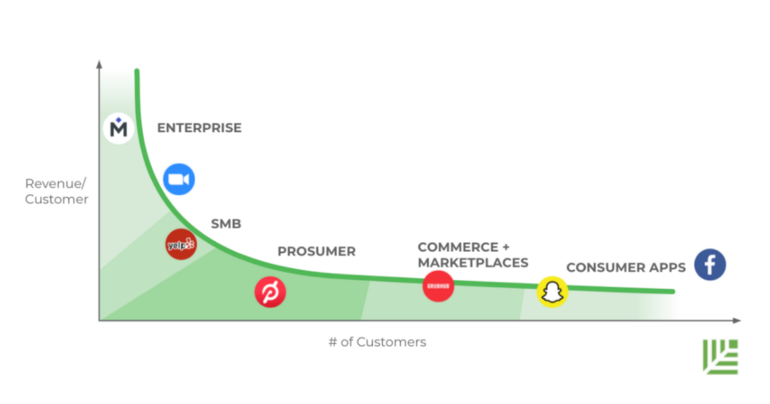
  1. The Market Curve. Mike Vernal from Sequoia points out that a great product is not sufficient for a great business — a great market is needed too. In this essay, Mike introduce the concept of “Market Curve,” a  long-tail curve for the relationship between the number of customers and revenue per customer variables for a given Market size. Mike divides companies into five categories (Enterprise, SMB, Prosumer, Commerce + Marketplaces, and Consumer Apps) and offers some great examples for each type.
  2. Moving upmarket and the ascent of SMB SaaS. Adam Fisher from Bessemer Venture Partner shares his thoughts on how SMB SaaS companies could move to the left side in the Market Curve. There are two broad types of go-to-market strategies. One is the Customer-pull strategy, which relies on the growth of customers. The other is the Bottom-up strategy, which targets individual employees or specific types of employees as entry points within an organization. Adam then shared ten best practices for SMB-focused SaaS vendors to move to the upmarket.
  3. To own or not to own delivery? Grocers reassess the Instacart dilemma. This article discusses the dilemma food retailers need to face in dealing with eCommerce platforms like Instacart. I have been relying on service like Instacart since the start of the pandemic. This weekend is the first time I do grocery shopping in a physical store, and it feels very strange (and inefficient) to me. I think grocery eCommerce will continue to be a thing after the pandemic ends.

Interesting Facts

  • How could plankton in the Cretaceous influence modern American politics? This fascinating tweet stream summarizes the formation of a “swoosh” of counties in red states that consistently vote for the democratic party in the past decades. In the Cretaceous, the area was the coastal shore where millions of plankton live. As the planet cools down, the oceans recede. But the dead bodies of plankton make the soil extra organic and more suitable for cotton to grow. As a result, many African-Americans whose ancestors worked in cotton plantations live nowadays in the region, and they vote for democrats. You could also read this essay and this wiki for more descriptions of this interesting link between ancient history and modern politics.

Fun

Categories
Newsletter

Conan’s Newsletter No. 13

This is an overwhelming week for everyone, so I will only recommend one book — a book about a president. Nothing more and nothing less.

The book is Destiny and Power: The American Odyssey of George Herbert Walker Bush. The 41st President’s biography also gives a great view of American politics from the sixties to the end of the 20th century. Is there a better time than now to reminisce about American traditions?

Bush’s road to Whitehouse was by no means rosy. He experienced much more failure than success throughout his career. He was defeated twice for his Senate bid (1960 and 1970), lost to Regan in the 1980 republican primary, and failed to get a second term. The loss of the 1992 presidential election to Bill Clinton was exceedingly hurtful for him. He called the pain “ghastly” many years after he left the Whitehouse.

No matter what happened, the 41st president held on American values and traditions to his heart. He had rivals but virtually no enemies, and he had proven himself an attractive and reliable man to those who know him. 

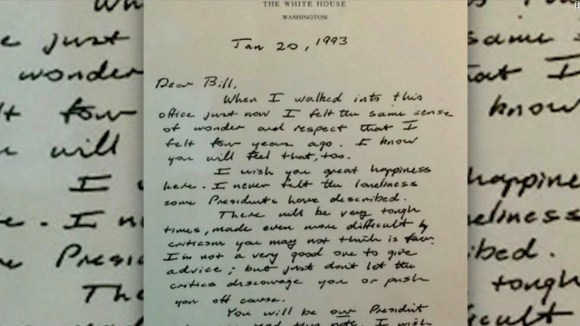
Nothing is more exemplar than his handling of the government transition after the agonizing defeat. In a Whitehouse tour after the election, Bush told Clinton: “I want to tell you something when I leave here; you are going to have no trouble for me. The campaign is over. It was tough, but I’m out of here, and I will do nothing to complicate your work, and I just want you to know that.”  He also left a well-wish letter for Bill Clinton when he left the Whitehouse — a beautiful symbol for American value. Even without his other outstanding achievements, this letter alone would make George H.W. Bush a revered and memorable president.

The letter that George H. W. Bush left to Bill Clinton.

Categories
Newsletter

Conan’s Newsletter No. 12

Book of the Week

This memoir from the less famous Netflix co-founder Marc Randolf is an excellent read if you are interested in good stories about startups. Startup-founding stories are often about a group of genius, with a eureka moment, creates a terrific product to change the world. Those stories are beautiful but unfortunately less useful for us — the real world doesn’t work in that romantic way. Successful people are more hesitant to tell us the real story, and even if they do, they may have survivorship bias. As a result, I am always interested in the stories of either invisible founding members or companies that are not home-run hit.

Marc Randolph fits into that type: he is the founder of Netflix and its CEO for the first year, but he later departed and was outside the limelight. This book reveals many details about Netflix’s early days, including conceiving the idea and building initial prototypes. Marc also described a lot of his personal life when he was working on Netflix ideas. 

The book also includes some more drastic moments, e.g., when Reed Hastings — the more famous founder — sidelined Marc using a PowerPoint presentation and Marc’s eventual decision to depart Netflix. Many of the moments are personal and emotional, but Marc describes what happened from his perspective objectively. He is honest about his limitation and was in full respect of Reed Hasting and all his decisions. He sets his contribution to Netflix straight but gives Reed the most credit for what Netflix had achieved.

Productivity

GOTO 2012 • Scaling Yourself • Scott Hanselman. This video is a great and fun tutorial from Scott Hanselman about improving your focus and productivity. Although I already know many concepts, I still watched it end-to-end because Scott presents those concepts delightfully and exactly.

One tip I find interesting is here“Conserving your keystrokes is important … You should never write a long email to someone, anything longer than three sentences should be in Blogs/Wiki/Product document/Knowledge database, anywhere but in your email. Email is where your keystrokes die”.

Technology

  1. How to price your SaaS product. This excellent article from Patrick Campbell discusses the pricing of SaaS products. Here are my takeaways from the report:
    1. There are three critical steps for reasonable pricing.  1) Understand and quantify what value you bring to your customers. 2) Understand what your ideal customer profiles are. 3) Do user research and experiment frequently.
    2. Patrick also offers ten rapid-fire bonus tips. Her some interesting ones to me:
      1. Revenue per customer is 30% higher when you use the proper currency symbol. 
      2. In B2B, value propositions can swing the willingness to pay ±20%. In DTC, it’s ±15%
      3. Don’t discount over 20%. Large discounts get people to convert, but they don’t stick around.
      4. Social proof is important. Case studies can boost willingness to pay by 10-15% in both B2B and in DTC
      5. Design helps boost the willingness to pay by 20%.
  2. Measuring the engagement of an open-source software community. This study from Bessemer Venture Partners discusses the metrics that are useful to measure open-source communities’ engagement. My takeaways:
    1. The authors think the North Star metric for a project is its unique monthly contributor activity. A contributor is any user that has created a Github Issue or Issue Comment, or logged a Pull Request or Commit in a given month. 
    2. Out of the top 10,000 projects, only 2% have reached 250 monthly contributors in 6 or more months. One hundred contributors per month is a substantial milestone.
    3. The authors expect more and more companies will open-source their core technologies—for the mutual benefit that open source provides to both the community and the company—and focus on monetizing only a small portion of their user base. 

Other Stuff

Cecilia Chiang, an S.F. legend and the matriarch of Chinese food in America, dies at 100. Chiang’s incredible life goes beyond food and encapsulates the 20th-century history of Chinese culture in San Francisco. Chiang fled from China in 1949, first went to Japan, and then came to the US to found the groundbreaking Mandarin restaurant. She changed the course of Chinese restaurants in America. She introduced many dishes that become the canon for Chinese food in the United States: potstickers, hot-and-sour soup, sizzling rice soup, beggar’s chicken, and the bestseller, smoked tea duck.

Chiang is also the subject of a documentary: Soul Of A Banquet (amazon prime videoYoutube trailer)