Recently, there’s been an interesting development in the big model industry. Perplexity AI, a hot big model company in Silicon Valley, completed a financing round two months ago, valuing it at over $500 million. However, using Lepton AI’s middleware, Lepton’s co-founder Jiayang Qing managed to create an open-source version with just 500 lines of code over a weekend, sparking a heated discussion in the industry. The related demo on GitHub quickly garnered five thousand stars in just a few days. This incident reflects a broader trend, and I’ll analyze it based on my own year and a half of entrepreneurial experience.
Currently, big model companies can be categorized into three types:
Base model companies, which primarily provide big model capabilities. This area requires significant capital and resources are highly concentrated among leading companies and giants.
Middleware companies, which offer middleware between big models and applications. Jiayang Qing’s Lepton AI falls into this category.
Application-layer companies, which directly provide consumer-facing applications. These can further be divided into platform-type application companies, like Perplexity AI, and vertical application companies focusing on niche markets, such as Harvey AI, which recently completed financing for its legal application.
The incident with Perplexity AI and Lepton AI highlights a pain point for application-layer companies — high competitive pressure with insufficient moats. For instance, Perplexity, which aims to solve general information search problems, faces challenges from four fronts: pressure from giants like Google, competition from vertical knowledge applications like Harvey, market encroachment from other knowledge service companies, and disruptions from middleware companies like Lepton AI. Vertical application companies face slightly less pressure, but they still confront these four forces and have a smaller market size, resulting in fewer resources.
So, what can be done? Many entrepreneurs believe that accumulating proprietary data can create a sufficient moat. This is very sensible, but it presupposes a systematic methodology for acquiring proprietary data. Here, I propose a methodology: using contrarian insights to gain a time advantage, leveraging the founder’s personal strengths for breakthroughs, and focusing on data-first products or operational capabilities.
First, contrarian insights, or insights not commonly understood, are essential. Entrepreneurs must find less trodden paths to build their core competitive advantage with minimal resources. What was once a contrarian insight can become common knowledge, such as the combination of big models with chat interfaces, which was novel before ChatGPT but is now common.
Second, the founder’s personal advantage is crucial. While contrarian insights offer temporary protection, they quickly become common knowledge once proven useful. Here, a deep understanding of user pain points in vertical applications can be a personal advantage. For example, one of Harvey’s co-founders was a lawyer. Even if a team doesn’t have a co-founder from a specific industry, previous experiences that can be leveraged as industry advantages are valuable.
Finally, building a data-first product or operational capability is key. The founder’s personal advantage must be systematized to sustain. There are two strategies:
Product-driven: The founder uses their deep understanding of user needs to design a product that naturally accumulates high-quality data, enhancing the product experience and creating a flywheel effect.
Operation-driven: The founder uses their resources and experience to build an operational system that continually acquires proprietary data, making operations or sales more efficient and faster.
The former suits products focused on Product-led Growth (PLG), while the latter suits those driven by Sales-led Growth (SLG). Both must prioritize data. If product-driven, each feature should contribute to data accumulation. If operation-driven, operations should focus on data, not just revenue or other metrics.
Returning to Perplexity’s case, Jiayang Qing could replicate Perplexity’s main functions over a weekend but not its data accumulation. As a middleware company, Lepton likely doesn’t intend this as a core strategy. However, many new application startups may use this to challenge Perplexity further. Whether Perplexity can withstand this depends on its ability to build a moat with proprietary data.
My name is Jing Conan Wang, a co-founder and CTO of Storytell.ai. In October 2022, together with two amazing partners DROdio and Erika, we founded Storytell.ai, dedicated to distilling signal from noise to improve the efficiency of knowledge workers. The reason we chose the name Storytell.ai is that storytelling is the oldest tool for knowledge distillation in human history. In ancient times, people sat around bright campfires telling stories, allowing human experiences and wisdom to be passed down through generations.
The past year has been an explosive one for large language models (LLMs). With the meteoric rise of ChatGPT, LLMs have quickly become known to the general public. I hope to share my own personal story to give people a glimpse into the grandeur of entrepreneurship in the field of large language models.
From Google and Beyond
Although ChatGPT comes from OpenAI, the roots of LLMs lie in Google Brain – a deep learning lab founded by Jeff Dean, Andrew Ng, and others. It was during my time at Google Brain that I formed a connection with LLMs. I worked at Google for five years, spending the first three in Ads engineering and the latter two in Google Brain. Not long after joining Google Brain, I noticed that one colleague after another began shifting their focus to research on large language models. That period (2017-2019) was the germination phase for LLMs, with a plethora of new technologies emerging in Google’s labs. Being in the midst of this environment allowed me to gain a profound understanding of the capabilities of LLMs. Particularly, there were a few experiences that made me realize that a true technological revolution in language models was on the horizon:
One was about BERT — one of the best LLMs before ChatGPT: One day in 2017, while I was in a Google Cafe, a thunderous applause broke out. It turned out that a group nearby was discussing the results of an experiment. Google provides free lunches for its employees, and lunchtime often brings people together to talk about work. A colleague mentioned to me: “Do you know about BERT?” At the time, I only knew BERT as a character from the American animated show Sesame Street, which I had never watched. My colleague told me: “BERT has increased Google Search revenue by 1% in internal experiments.” Google’s revenue was already over a hundred billion dollars a year, meaning this was equivalent to several billion dollars in annual revenue. This was quite shocking to me.
Another was my experience with Duplex: Sunder Pichai released a demo of an AI making phone calls at Google I/O 2018, which caused a sensation in the industry. The project, internally known as Duplex, was something our group was responsible for in terms of related model work. The demo only showed a small part of what was possible; internally, there was a lot more data on similar AI phone calls. We often needed to review the results of the Duplex model. The outcome was astonishing; I could hardly differentiate between conversations held by AI or humans.
Another gain was my reflection on business models. Although I had worked in Google’s commercialization team for a long time and the models I personally worked on generated over two hundred million dollars in annual revenue for Google, I realized that an advertising-driven business model would become a shackle for large language models. The biggest problem with the advertising business model is that it treats users’ attention (time) as a commodity for sale. To users, it seems like they are using the product for free, but in reality, they are giving their attention to the platform. The platform has no incentive to increase user efficiency but rather to capture more attention to sell at a very low price. Valuable users will eventually leave the platform, leading to the platform itself becoming increasingly worthless.
One of the AI applications I worked on at Google Brain was the video recommendation on YouTube’s homepage. The entire business model of Google and YouTube is based on advertising; longer user watch time means more ad revenue. Therefore, for applications like YouTube, the most important goal is to increase the total time users spend on the app. At that time, TikTok had not yet risen, and YouTube was unrivaled in the video domain in the United States. In YouTube’s model review meetings, we often joked that the only way for us to get more usage is to reduce the time people spend eating and sleeping. Although I wanted to improve user experience through better algorithms, no matter how I adjusted, the ultimate goal was still inseparable from increasing user watch time to boost ad revenue.
During my contemplation, I gradually encountered the Software as a Service (SaaS) business model and felt that this was the right model for large-scale models. In SaaS, users only pay for subscriptions if they receive continuous value. SaaS is customer-driven, whereas Google’s culture overly emphasizes an engineering culture and neglects customer value, making it very difficult to explore this path within Google. Ultimately, I was determined to leave Google and decided to start my own SaaS company. At the end of 2019, I joined a SaaS startup as a Founding Member and learned about the building process of a SaaS company from zero to one.
At the same time, I was also looking for good partners. Finally, in 2021 I was able to meet two amazing partners DROdio and Erika and we started storytell.ai in 2022.
Build a company of belonging
The first thing we did at the inception of our company was to clarify our vision and culture. We want to build a company of belonging by defining our vision and culture clearly. The vision and culture of a company truly define its DNA; the vision helps us know where to go, and the culture ensures we work together effectively.
Storytell’s vision is to become the Clarity Layer, using AI to help people distill signal from noise (https://go.storytell.ai/vision). — a company with great vision and culture.
We have six cultural values: 1) Apply High-Leverage Thinking. 2) Everyone is Crew. 3) Market Signal is our North Star. 4) We Default to Transparency. 5) We Prioritize Courageous Candor in our Interactions. 6) We are a Learning Organization. Please refer to this https://go.Storytell.ai/values for details.
We also pay special attention to team culture building during the company’s creation process. From the start, we hope to work hard but also play harder. We have offsite gatherings every quarter. The entire team is very fond of outdoor activities and camping, so we often hold various outdoor events (we have a shared album with photos from the very first day of our establishment). We call ourselves the Storytell Crew, hoping that we can traverse the stars and oceans together like an astronaut crew.
Build a Product that people love
In the early stages of a startup, finding Product-Market Fit (PMF) is of utmost importance. Traditional SaaS software emphasizes specialization and segmentation, with typically only a few companies iterating within each niche, and product stability may take years to achieve. This year, ChatGPT brought about a radical market change. The explosive popularity of ChatGPT is a double-edged sword for SaaS software entrepreneurs. On one hand, it reduces the cost of educating the market; on the other hand, the entire field becomes more competitive, with a surge of entrepreneurs entering the market and diverting customer resources. The influx of ineffective traffic brought by ChatGPT ultimately fails to convert effectively into the product.
Many believe that the moat for startups applying large models is technology or data. We think neither is the case. The real moat is the skill in wielding this double-edged sword. Good swordsmanship can transform both edges of the sword into a force that breaks through barriers:
On one hand, for traditional SaaS, it’s about leveraging the momentum of ChatGPT to maximize the impact on traditional SaaS. Make customers feel the urgency to keep up with the times. Develop AI Native features that incumbents find hard to follow.
On the other hand, use the competition to bring about a thriving ecosystem and have a methodical and steadfast approach in product iteration, ultimately shortening the product iteration cycle to achieve the greatest momentum.
We follow these two principles in our own product iteration.
1) Data-guided: In the iteration process, we use the North Star Metric to guide our general direction. Our North Star Metric is:
Effective Reach = Total Reach x Effective Ratio
Total reach is the number of summaries and questions asked on our platform each day. The Effective Ratio is a number from 0 to 1 that indicates how much of the content we generate is useful for users.
2) User-driven. Drive product feature adjustments through in-depth communication with users. For collecting user feedback, we’ve adopted a combination of online and offline methods. Online, we use user behavior analysis tools to identify meaningful user actions and follow up with user interviews to collect specific feedback. Offline, we organize many events to bring users together for brainstorming sessions.
With this approach in mind, our product has undergone multiple rounds of iteration in the past year.
V0: Slack Plugin
Since June 2022, Erika, DROdio and I have been conducting numerous customer discovery calls. During our interviews with users, we often needed to record the conversations. We primarily used Zoom, but Zoom itself did not provide a summarization tool back then. I used the GPT-3 API to create a Slack plugin that automatically generates summaries. Whenever we had a Zoom meeting, it would automatically send the meeting video link to a specific Slack channel. Subsequently, our plugin would reply with an auto-generated summary. Users could also ask some follow-up questions in response.
At that time, there weren’t many tools available for automatically generating summaries, and every user we interviewed was amazed by this tool. This made us gradually shift our focus towards the direction of automatic summarization. The Slack plugin allowed us to collect a lot of user feedback. By the end of December 2022, we realized the limitations of the Slack plugin.
Firstly: Slack is a system with high friction. Only system administrators can install plugins; regular employees cannot install plugins themselves.
We had almost no usage of our Slack plugin over the weekends. The likelihood of users using Slack in their personal workflows was low.
Slack’s own interface caused a great deal of confusion for our users.
V1: Chrome Extension
We began developing a Chrome extension in December 2022, primarily to address the issues mentioned above. While Chrome extensions also have friction, users have the option to install them individually. Chrome extensions can also automatically summarize pages that users have visited, achieving the effect of AI as a companion. Additionally, Chrome extensions facilitate better synergy between personal and work use. During the iteration process of the Chrome extension, we realized that chat is one of the most important means of interaction. Users can accurately express their needs by asking questions (or using prompt words). Although we allowed users to ask questions during the Slack phase, the main focus was still on providing a series of buttons. In the iteration process of the Chrome extension, we discovered that the chat interface is very flexible and can quickly uncover customer needs that weren’t predefined.
On January 17th, we released our Chrome extension. However, on February 7th, Microsoft released Bing Chat (later known as Copilot), integrated into Microsoft Edge. By March, the Chrome Store was flooded with Copilot copycats. We quickly realized that the direction Copilot was taking would soon become a saturated market. Additionally, during the development of our Chrome extension, we became aware of some bottlenecks. The friction in developing Chrome extensions is quite high. Google’s Web Store review process takes about a week. This wouldn’t be a problem in traditional software development, but it’s very disadvantageous for the development of large models. This year, the iteration speed of large models is essentially daily. If we update only once a week, it’s easy to fall behind.
V2: VirtualMe™ (Digital Twin)
In March 2023, we began developing our own web-based application. Users can upload their documents or audio and video files, and then we generate summaries, allowing users to ask corresponding questions. Our initial intention was to build a user interaction platform that we could control. The development speed of the web-based application was an order of magnitude faster than the Chrome extension. We could release updates four to five times a day without waiting for Google’s approval. Moreover, with the Chrome extension, we could only use a small part of the browser’s right side. There were many limitations in interaction, but with the web-based platform, we have complete control over user interactions, allowing us to create more complex user-product interactions.
During this process, we learned that it is very difficult to retain users with utility applications. Users typically leave as soon as they are done with the tool, showing no loyalty. Costs remain high. Moreover, with a large number of AI utility tools going global, the field is becoming increasingly crowded.
We began deliberately filtering our users to interview enterprise users and understand their feedback. By June 2023, we realized that the best way to increase user stickiness was to integrate tightly with enterprise workflows. Enterprise workflows naturally result in data accumulation, and becoming part of an enterprise’s workflow enhances the product’s moat.
We started thinking about how our product could integrate with enterprise workflows. We came up with the idea of creating a personified agent. Most of the time when we encounter problems at work, we first ask our colleagues. A personified agent could integrate well with this workflow. We quickly developed a prototype and invited some users for beta testing.
Our initial user scenario envisioned that everyone could create their own digital twin. Users could upload their data to their digital twin so that when they are not online, it could answer questions on their behalf. After launching the product, we found that the most common use case was not creating one’s own digital twin, but creating the digital twin of someone else. For instance, we found that product managers were heavy users of our product. They mainly created digital twins of their customers to ask questions and see how the customers would respond.
During the VirtualMe™ phase, we began to refine our enterprise user persona for the first time. We identified several user personas, mainly 1. Product Managers, 2. Marketing Managers, 3. Customer Success Managers. Their common characteristic is the need to better understand others and create accordingly.
At the end of July, we organized an offline event and invited many users to test our VirtualMe product together. They found our product very useful, but they had significant concerns about the personified agent. Personal branding is very important for our user group. They were worried that what the virtual twin says could impact their personal brand, especially since large models generally still have the potential for “hallucination.”
It was also at this event that users mentioned the part of our product they found most useful was the customizable Data Container and the ability to quickly generate a chatbot. At that time, no other product on the market could do this.
V3: SmartChat™
Starting in August, we began to emphasize data management features based on this approach and launched SmartChat™. In SmartChat™, once users upload data, we automatically extract tags from the content. Users can also customize tags for data management. By clicking on a tag, the ChatBot will converse based on the content associated with that tag. At the same time, we also launched an automation system that runs prompts for users automatically, pushing the results to the appropriate audience via Slack or email.
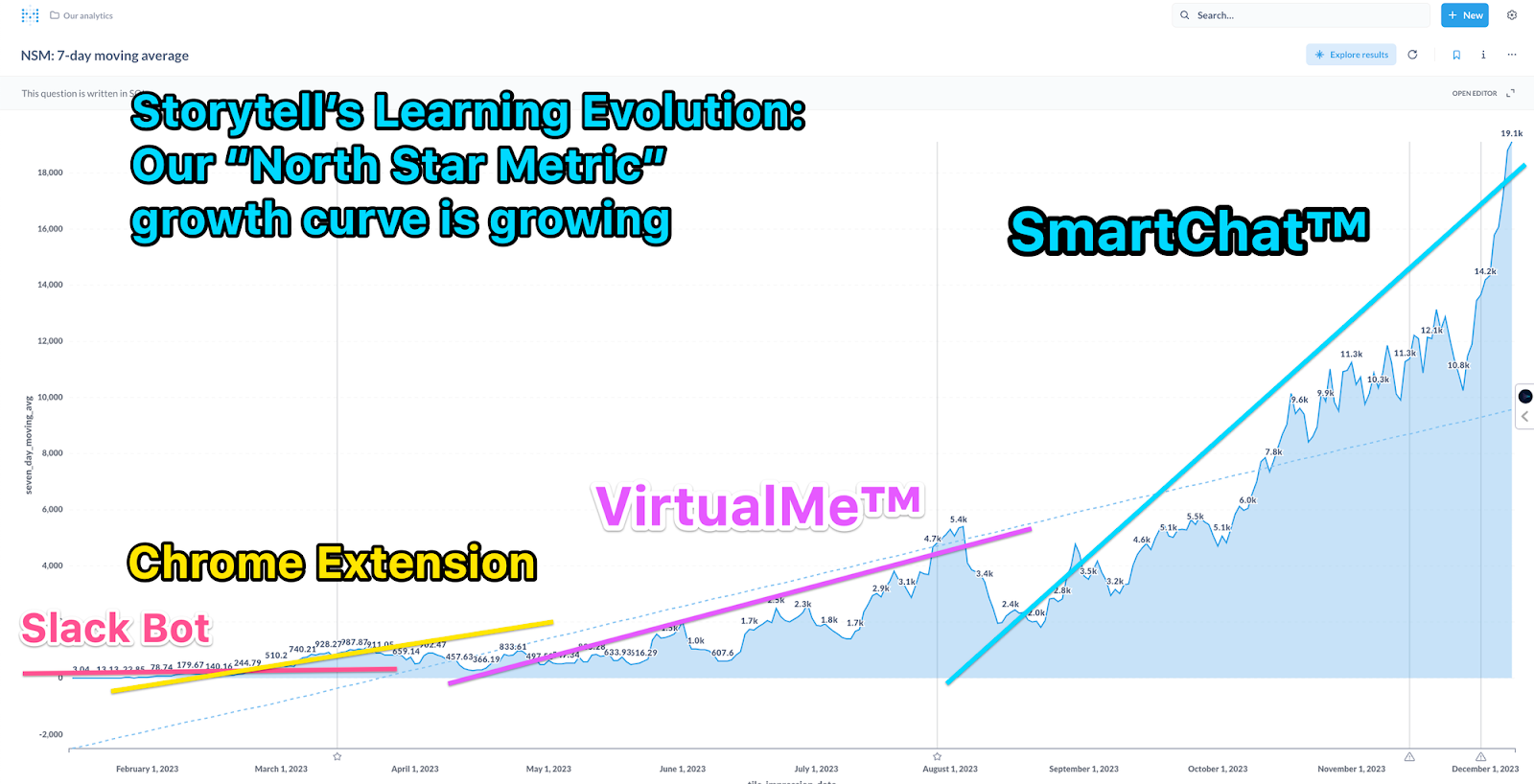
The following figure shows our North Star Metric (NSM) up to December 1st of this year. At the beginning of the year, during the Slack plugin phase, our NSM was only averaging around 1. During the Chrome Extension phase, our NSM reached the hundreds. VirtualMe™ pushed our NSM up to 5,000.
By early December, our NSM was close to 20,000. Previously, our growth was entirely organic. By this time, we felt we could start to do a bit of growth hacking. In December, we started some influencer marketing activities, and our NSM grew by 30 times, reaching 550K!
From an NSM of less than 1 at the beginning of the year to 550K by the end of the year, in 2023 we turned Storytell from a demo into a product with a loyal user base. I am proud of our Crew and very grateful to our early users and design partners.
Words at the end
From a young age, I have been particularly fond of reading books on the history of entrepreneurship. The year 2023 marks the beginning of a new era for me to embark this journey. I know the road ahead is challenging, but I am fortunate to experience this process firsthand with my two amazing partners and our Crew. Regardless of the outcome, I will forge ahead with all the Storytell Crew, fearless and without regret. Looking forward to Storytell riding the waves in 2024!
Also, Storytell.ai is hiring front-end and full-stack engineers: https://go.storytell.ai/fse-role. If you are interested or you know anyone might be interested, please don’t hesitate to contact me at my email jingconan@storytell.ai.
Last week, an intriguing discussion caught my attention at a fantastic event organized by Leni. The panel discussion revolved around an interesting comparison: Will the Generative AI industry resemble the Coffee industry, with a dominant player like Starbucks, or the Winery industry, characterized by a multitude of providers offering differentiated products?
This thought-provoking question led me to delve deeper into the dynamics of the Generative AI industry. Here are my thoughts.
In any industry, two key factors significantly influence its structure – the fixed and marginal costs of producing the product and the price for each unit of service. Let’s consider the Coffee and Winery industries for context.
In the Coffee industry, the high fixed cost – primarily branding – incentivizes scaling. Starbucks, for instance, has invested heavily in establishing a formidable brand and hence, scales up to distribute the cost. On the contrary, the Winery industry thrives on differentiation, with numerous wineries offering unique products.
Now, let’s apply these factors to the Generative AI industry. The industry can be divided into three essential layers as per the framework described by A16z:
1) The Infrastructure layer, which runs training and inference workloads for generative AI models.
2) The Foundational Model Layer, which provides the Foundational model via a proprietary API or open-source model checkpoints.
3) The Application Layer, where companies transform generative AI models into user-facing products, either by running their own model pipelines (“end-to-end apps”) or relying on a third-party API.
For the Foundational Model vendors, there’s a high fixed cost involved in training the models, and the marginal cost of providing a unit of service (API call) is quite low. Moreover, most sales are made through API calls, which have a low unit sale price. This dynamic, coupled with the fierce competition and the rise of competitive open-source alternatives, is causing the pricing power of Proprietary API vendors to shrink rapidly. As a result, the Foundational Model market is likely to resemble the Coffee industry, where you either go to Starbucks (OpenAI), or you make your own coffee (Open Source). Infrastructure layer has very similar dynamics as the Foundational Model layer so I will skip it in this discussion.
Moving to the Application Layer, it’s essential to differentiate between consumer and enterprise applications. Consumer applications are likely to follow the Coffee industry’s pattern due to the significant fixed cost of creating a consumer-facing brand and the strong incentive to scale.
However, enterprise applications might mirror the Winery industry. With the wide availability of LLM APIs, creating an enterprise AI application no longer requires a substantial fixed cost. Although there are some fixed costs required for enterprises (e.g., data compliance), they are not on the same level as training LLM and can be sequenced in the iteration with customers. Moreover, the price for enterprise applications can be quite high (up to 6 or 7-figure for a single account), fostering an expectation for differentiated services.
In conclusion, the Generative AI industry presents a unique blend of the Coffee and Winery industries’ dynamics. The Foundational Model Layer and consumer applications at the Application Layer are akin to the Coffee industry, while enterprise applications at the Application Layer resemble the Winery industry. As the industry evolves, it will be fascinating to see how these dynamics play out.
This blog is finished with the help of SmartChat™ by Storytell.ai (both in the stage of researching content and rewriting the final draft). It is available for initial testing. Please sign in at storytell.ai and click dashboard like this https://share.getcloudapp.com/nOuLGPGN to access this feature.
I grew up in a very risk-reverse family. Although my parents’ home was only 0.5 miles away from many beautiful lakes, I was never allowed to swim because my parents were worried that I would be drowned. Not wanting to worry my parents, I always followed a safe path in my life. Staying safe became my habit — a regretful one.
I have wanted to be an entrepreneur since 15. However, it took me another 17 years before I took the plunge. I used to think that it was the lack of technology skills that prevented me from being an entrepreneur.
However, even after I worked my way up to Google Brain, one of the most renowned tech innovation labs, I was still unable to make up my mind to be an entrepreneur. I was frustrated, distraught, and unsatisfied.
Fortunately, I eventually found my way thanks to a pivotal moment in my life. In Nov 2021, my little Angel Adalyn was born and gave me a whole new perspective on life. I was in the same position with my parents 30 years earlier — Do I want Adalyn to be safe for me, or be herself?
I didn’t want to make a decision for her. I wanted to show her how I would do for myself.
I am also so grateful to meet DROdio who showed me how to be an adventure dad. I started by stocking up camping gears and did long road trip with my SUV. Eventually, I became a #Vanlifer and a proud owner of Winnebago.
Jing is with his families in their first trip in their Winnebago Van
Both being a Dad and being a vanlifer changed my perspective. I started to embrace adventure and explore new worlds in my life.
Eventually, it led to a wonderful new adventure to build Storytell.ai with two amazing partners DROdio and Erika. We had so much fun together to bring Storytell.ai from an idea to where we are.
Jing, DROdio, and Erika in a Halloween Party organized by an investor
We also build our venture as an adventure.
DROdio’s (Right) and Jing’s van (left) parked in the Storytell.ai’s Tahoe Offsite (Dec 2022)
Jing was working at a Catamaran for our Storytell advisor & user offsite at BVI. Thanks Elon! (June 2023)
Jing and Storytell advisor Asa and user Phin sailed at BVI. Jing and Phin also shipped an MVP on the ship.
We are still small, but we are fearless. There is always ups-and-downs in startup building, but there is also so much fun of experiencing adventure together with a group of like-minded friends.
I am proud to be be an adventure Dad and adventure CTO.
If I ever build a time machine to tell younger myself one tip. I will say to him: Be yourself, be adventurous.
We are currently in the midst of a boom era for Generative AI, and the landscape is changing almost daily. For more details, please refer to this blog post. The possibilities seem endless!
However, this is also an increasingly confusing time for builders. After spending months fine-tuning GPT-3, you may wake up to find that the model is now irrelevant due to the availability of GPT-4. Similarly, while working on building your workflow, you may discover that AutoGPT has taken over your niche.
In this fast-changing era, it’s crucial to build a solid foundation that allows you to leverage the benefits of the generative AI revolution.
FAST Framework
We introduce the FAST Framework for describing the characteristics of a tech team suitable for building a generative AI product. The FAST Framework consists of four elements:
Flexibility: To support product pivots without wasting a lot of work.
Accuracy: To ensure that AI generates valuable results for users.
Scalability: To enable a good user experience at a large scale and cost-effectively.
Tight-knit development workflow: To allow the team to build products with user feedback in a high-velocity manner.
How Storytell Plans to build our Technology Foundations
Let me explain how Storytell plans to incorporate the framework. To begin, let me describe the Storytell system at a high level. Our technology stack primarily consists of three systems:
The front-end system, which includes anything related to user interface and user interaction.
The back-end system, which handles data processing.
The AI system, which is our core algorithm for distilling signal from noise.
Flexibility
For the front-end system, one of the key challenges is to be flexible enough to adapt to different distribution channels such as the Chrome Web Store, Apple App Store, websites, and Slack App. Each channel has its own front-end UI development guideline. However, as the current AI era represents a paradigm shift, it is unclear which channel will eventually emerge as the winner. Therefore, it is essential to be able to experiment quickly at this stage. This often means revamping the front-end UI every few months. It would be a huge waste of effort if a team had to start from scratch each time they need to prioritize a new distribution channel.
The critical challenge for AI systems is to design an architecture that is agnostic to changes in the generative AI platform. For an overview of the generative AI platform, please see this A16z blog.
Accuracy
Accuracy has been a major issue for Large Language Models (LLMs), which are the workhorses of generative AI. LLMs from Google, OpenAI, and Microsoft all suffer from “hallucinations,” in which the AI confidently generates fake statements. Accuracy is a significant obstacle to applying LLMs to high-value use cases, such as enterprise applications. Any company working in the generative AI field must have a systematic way to improve accuracy of their AI system.
Two capabilities are required to address accuracy problems.
Fast user feedback and adaptive learning. Users should have the ability to report inaccuracies, and the system should be able to quickly adapt to feedback.
System to Ensure Accuracy: An AI system should adhere to certain rules or guarantees. One important rule is that the output should never be inappropriate. Additionally, due to the probabilistic nature of LLMs, it is necessary to build a software stack on top of them to ensure accuracy.
Scalability
Generative AI can be both expensive and slow. While APIs like OpenAI and open source models like LLaMA have made it easier to build generative AI systems, it remains challenging to build a scalable back-end system. The fast-changing landscape of generative AI makes this particularly difficult.
If you choose to use an API, the latency is often very high. Therefore, you need to design a system that can accommodate this latency. On the other hand, if you choose to use open-source models, the accuracy is likely to be worse. In this case, you need to design a system that can improve accuracy, for example, by using certain types of fine-tuning. Additionally, you need to design your system to tune efficiently because the base models change very rapidly.
Many API and open-source models have limits on the maximum amount of text you can send to the API, known as the token limit. To ensure that your system works within this limit and does not negatively impact your model’s performance, you need to design it accordingly.
Many API providers specify a maximum quota for API calls. You will need to work within this requirement by minimizing the number of API calls made.
Tight-knit development workflow
The typical product development cycle involves the following steps: user feedback collection -> feature prioritization -> development -> feature impact analysis. It is crucial to accelerate this cycle and make it as continuous as possible.
When collecting user feedback, you may have a separate customer team responsible for its collection. However, it is crucial for your engineers to also listen to user feedback. This requires having a development team that is highly focused on the needs of users.
Having a systematic way to identify important features that will benefit the business is crucial for feature prioritization. It’s essential to align the entire team with a single metric, known as the north-star metric. Prioritization should be done on a daily basis, rather than quarterly.
For software development, it is essential to be able to ship code as quickly as possible. Both technology capabilities and market needs are evolving rapidly. To find a product-market fit, you need to move faster than both. This means you need to be able to ship code continuously. Investment in software development lifecycle (SDLC) tools and continuous integration/continuous delivery (CI/CD) systems is crucial.
For feature impact analysis, it is important to collect user data as early as possible. This allows you to analyze user patterns and identify the top use cases. It is also worthwhile to invest in the business intelligence stack early on.
We are currently hiring for our Backend/ML role. If Storytell’s vision resonates with you and you want to help build it, please email me at jingconan@storytell.ai. For more information, please visit our career page and vision statement.
How has economic evolution changed the way birthday cakes are made? In their classical Harvard business review article, Joseph Pine IIand James H. Gilmore asked this question and gave their answer:
In an agrarian economy, parents make birthday cakes by themselves.
In an industrial economy, parents purchase premixed ingredients from the market.
In a service economy, parents order cakes as a yearly service for their kids.
In an experience economy, there will be “experience vendors” who could create an awesome birthday party for kids.
Their framework is also applicable to software.
Agrarian economy: every business needs to write software for their use cases.
Industrial economy: there are software vendors dedicated to building software, which could be purchased by customers to solve their needs.
Service Economy: The software is delivered as a service (often as a subscription) and it would still require customers to build upon the service to create an awesome experience. This is the Software-as-a-Service (SaaS) model.
Experience Economy: We are entering a new era of Software-as-a-Experience (SaaE). In the SaaE model, we use software to directly orchestrate experiences for our users. Software is not considered only a utility, but a conduit of digital experiences.
SaaE is a fundamental leap forward for the SaaS business model because it significantly reduces the friction for creating awesome user experiences. According to Joseph and James,
an experience occurs when a company intentionally uses services as the stage, and goods as props, to engage individual customers in a way that creates a memorable event. … No two people can have the same experience, because each experience derives from the interaction between the staged event (like a theatrical play) and the individual’s state of mind.
In the SaaS model, the software service itself is rigid. There is a predetermined way, often determined during the product build stage, to use the software. Users would continue their subscription only if the problem they face could be solved by the predetermined software flow. When this is no longer the case, customers would churn.
In the SaaE model, the software would be adaptive rather than rigid. The ultimate goal is to deliver the best experience to users by staging a sequence of software services intentionally.
To reach the goal, we need two new software layers:
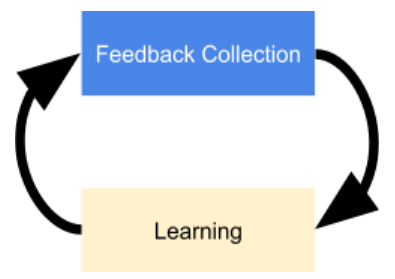
A feedback-collection layer that could continually integrate the feedback from each customer to the product.
A learning layer for software behaviors to adjust the software services to deliver the best customer experience.
Figure: Two layers of the SaaE.
The two layers were not practical in the software building process before because it would take an enormous amount of effort to personalize the software flow for each user.
The advancement of AI has made personalizing unique experiences for each user possible. We have already done it — YouTube’s personalized feed creates a unique video watching experience for every user, and Amazon’s product recommendation has created a unique purchase experience for every customer.
Those systems are currently referred to as recommendation systems. But this is just the tip of the iceberg for a large paradigm shift – the advent of the “Software-as-a-Experience” age.
Morris Chang may not be a household name in the western world but his achievement is comparable to that of western business Titans like Rockefeller and Carnegie. His life consists of one miracle by another. After fleeing from China to the US during the China Civil War, he worked his way up to be the general manager of the Semiconductor businesses and 3rd ranked person of Texas Instrument — one of the biggest semiconductors companies in the world. Chang was one of the first Chinese Americans to become top business leaders. In his 50s, he returned to Taiwan and founded Taiwan Semiconductor Manufacturing Company (TMSC) and became the “godfather” of Taiwan’s semiconductor industry.
Chang was born in China in 1931. Most of his early life was deeply shaped by war — he was forced to flee three times due to the Second Sino-Japanese war and China civil war. After the wars, he came to the United States at the age of 17 to study at Harvard University, a school that primarily focused on arts and humanities education. As an underrepresented minority ethnic group, most Chinese Americans at the time worked in low-end restaurants or laundry businesses. Academic jobs were the only few alternative options that would fit with Chang’s mission of achieving big societal impacts. He later transferred to MIT in the hope of becoming a scholar in engineering majors. Unfortunately, he failed the qualifying exams twice at MIT and had to quit his academic path and went to the job market after obtaining his master’s degree.
He entered the Semiconductor industry in his first job at Sylvania, an industry leader then. However, his team was dismantled three years later. He then moved to Texas Instrument, which was famous for the invention of integrated circuits (IC) and was fast-growing. After working at Texas Instrument for three years, he went back to Stanford to pursue a Ph.D. degree and then returned to Texas Instrument to continue his corporate duty. By the 1970s, Chang was already the general manager of the whole semiconductor business of Texas Instrument.
Chang was a keen observer of the semiconductor industry. While working at Texas Instrument, he observed that a lot of brilliant people in the company were hoping to create new businesses but heavy investment requirements prevented them from getting started. As chips became more and more sophisticated, the chip manufacturing business became super capital-intensive. The cost of creating a chip manufacturing line (also known as “foundry” or “fab”) could easily be over 3-4 billion US dollars. Besides, new startups cannot maintain a sustainable stream of needs to keep their manufacturing line busy all the time, which is the only way to justify the heavy investments.
In contrast, chip designing requires much less capital. It would be a win-win situation if there is a “pure-play” company that focuses on manufacturing so that startups could focus on designing. This model of chip making process, also known as Fabless manufacturing as it features the split of designing and manufacturing, is crucial for the booming of the semiconductor industry. There were a lot of chip design talents in the US, but very few were good at both chip manufacturing and cost management. Chang was one of the few talents who had the expertise.
Chang started to face career setbacks in the early 1980s. At the time, Texas Instrument shifted focus away from semiconductors and became a diversified device manufacturer. Chang disagreed with the shift and had to leave the company. After the career setback, Change decided to turn his observation into action. At the same time, Taiwan government was eager to find ways to break into high-end industries like chip manufacturing. Chang was the perfect person to lead the cause. After a short stint at another company, Chang accepted the invitation from the Taiwan government to be the first chairman of the Industrial Technology Research Institute, an institute that played a critical role in the industrial transformation of the island. With the support of the Taiwan government, Chang founded the TSMC one year later. TSMC created a whole new industry of “pure-play” chip manufacturing (a.k.a., foundry industry). By focusing on only manufacturing but not designing, TSMC assured its partners, typically US chip designing firms, that TSMC won’t compete with them or share their trade secrets with their competitors.
Now TSMC is undoubtedly the market leader in the industry and occupies 28% of the market share in a recent study. Also thanks to TSMC, Taiwan became crucial for the global semiconductor supply chain, which Bloomberg has recently published an article to illustrate.
Global semiconductor market share (image via Counterpoints Research)
In one of his recent talks, Chang gave a summary of what he thinks is the key reason for the TMSC’s success. Chang attributed the success to three factors.
The number one is Taiwanese people’s hard-working spirit. For example, during his second stint at TMSC, Chang started the “nightingale program”, which included both day and night shifts to ensure there were R&D activities 24/7. This program would be unimaginable in U.S. companies. According to Chang, this nightingale program was the key reason why the TSMC could eclipse all of its competitors in technology. In chip manufacturing, the size of the device the manufacturing process could produce is a key indicator of technology level — smaller size means more devices in the same area but also is much harder to manufacture. After losing in the competition of the 14nm manufacturing process, TSMC reached the 10nm, 7nm, and 5nm manufacturing processes one by one in just a few years. Till now, none of its competitors have reached the 10nm milestone yet. Please refer to RISC-V, China, Nightingales for more details.
Figure. The timeline of manufacturing process in major foundry companies.
The second factor is the local professional management. This factor is crucial because chip manufacturing is operation-heavy and efficiency-driven. Chang also mentioned that managerial talent doesn’t transfer well across borders because of culture and factors.
The third factor is the good infrastructure provided by the Taiwan government. It is easy to see how good infrastructure makes the transportation of goods much easier. Chang also mentioned an important point. The good high-speed railway and the small Island of Taiwan make it possible for talents to be relocated to any place within the island without the need to be separated from their families. The benefits of good infrastructure on the human management side are often ignored by governments but are crucial for businesses that require a lot of talent.
All the three points are about one thing: TSMC can attract a huge amount of disciplined and high-quality talent and can retain them through good management and providing a convenient life. The company has an envious 3-4% employee turnover rate. For those who leave for various reasons, they became the most sought-after talents in the industry. I also highly recommend this great essay by Kevin Xu based on Chang’s talk.
Throughout his life, Chang overcame one challenge by another and successfully turned setbacks into new opportunities. Although he became a refugee three times in his youth, he immigrated to the US to pursue a new life. After failing in MIT Ph.D. qualifying exams and crumbling his academic pursuit, Chang entered the newborn semiconductor industry and worked tirelessly to become an expert in semiconductor manufacturing. After facing a career setback in Texas Instrument, he took the courage to leave the US, a place he had spent 36 years, to Taiwan for creating TSMC and became the godfather of the semiconductor industry of the Island.
Chang is also a great writer. I highly recommend his Chinese autobiography that covered his early life before 33 years old (unfortunately I haven’t found any translated version yet). Besides, he is working on the second half of this auto-biography, and hopefully, will publish it soon. I am very much looking forward to reading it and will share a sequel in the future.
For people who are interested in artificial intelligence, the past decade feels like another Renaissance — the boundaries between humans and machines are repeatedly re-defined by the invention of new technologies, from machines that could beat world Champions in games to AI assistants that could talk like real humans.
This article shares some stories behind this incredible AI Renaissance. The sources of the stories include my first-hand observation in the field as well as Cade Metz’s recent book Genius Makers, which I highly recommend.
A Sputnik Moment
A key reason for the current revolution is the re-invention of deep learning, a technology that simulates human brains as complex network architectures through computers.
The idea is not new. Scientists have been searching for the truth of human intelligence for a long time, and a natural starting point is our brain — the only intelligent machinery built by our mother nature. Artificial neural networks, predecessors of deep learning, were very popular between the 1950s and 1980s but lost their popularity because data was not enough and the computers then were too weak to solve any interesting problems.
It would take another two decades before its revival. In the late 2000s, a group of young scientists started to connect the power of the booming Internet with artificial intelligence research. In 2009, an assistance professor of Princeton Dr. Fei-fei Li1 compiled a vast database of Internet images (a.k.a. ImageNet dataset). The ImageNet dataset soon became the benchmark for Computer Vision, a subfield of artificial intelligence. In 2012, Geoffroy Hinton and his team significantly improved the metrics by more than ten percent, a jaw-dropping achievement that was a magnitude higher than any previous improvement.
This was a “Sputnik moment” for the artificial intelligence research community, at the time the mainstream research direction was for scientists to figure out the solution and to program the software based on the solution. Hinton’s success in the ImageNet challenge showed that an alternative approach — letting the neural networks learn a solution without prescription from humans — would work better.
Godfather is Heading to Industry
Huge amounts of data and computer resources were essential to this success. No one knew this better than Geoffroy Hinton himself, who is also known as the Godfather of deep learning. Hinton was one of the early persons that popularized back-propagation, a fundamental algorithm used to train neural networks. When the field entered into a winter between the 1990s and early 2000s, most researchers switched to other research directions due to scarce funding sources. However, Hinton was still a stubborn proponent of the idea and was trying to revive it.
Hinton knew that his research would need resources from elsewhere, and only the big Internet companies had the pocket deep enough and data big enough to make the idea work. In addition to his academic achievement, Hinton also had great business savvy. With his two students, Hinton founded the DNNResearch company in 2012 and soon decided to sell it to big Internet companies. The book Genius Makersgave a vivid description of how Hinton orchestrated the auction in a Lake Tahoe hotel and how tech companies all over the world wooed him. DNNResearch was eventually acquired by Google for 44 million US dollars.
More important than the price tag is the precedence that Hinton created. To lure Hinton, Google allowed him to keep his position on both sides — but he had to be an “intern” in Google to work around the company’s rules. Before Hinton, it was rare for eminent researchers to work for tech companies because of the fear of losing their tenured positions in universities. Soon after the purchase, a lot of AI researchers followed Hinton’s example to join technology companies, including Yann LeCun, another deep learning pioneer who later led Facebook’s AI lab, Andrew Ng, who led the research lab in Baidu. What’s more, following their advisors, students from various research labs flocked into big technology companies.
Among the technology companies, Google (and its parent company Alphabet) stood out for its unparalleled role in this wave of AI Renaissance. Its research divisions — Google Brain and DeepMind — are the driving force behind a lot of the greatest breakthroughs. What’s more, the fact that it could use AI to create so many profitable applications has a demonstration effect on all other companies.
One important person behind this is Jeff Dean, a legendary engineer that laid the foundation of Google’s infrastructure. In 2011, Andrew Ng introduced the deep learning concept to Jeff and he was intrigued immediately. Jeff was looking for his next application and deep learning was a perfect one. Andrew, Jeff, and another researcher Greg Corrado founded the Google Brain team. As a founding engineer of Google, Jeff has a great influence on Google’s management team and also enjoys enormous popularity within its engineering and research organizations (so much so that people made fun of him by creating the “Jeff Dean facts“). Jeff created an umbrella where the Google Brain team could operate without worrying about anything else.
In Google Brain, Andrew Ng and his colleagues helped create the system that could learn the “cat” concept from millions of YouTube videos, which drew a lot of media attention and publicized the field. Andrew Ng eventually left the Brain team to work on his own startup. But he recommended Geoffroy Hinton as his replacement, which triggered the DNNResearch acquisition. Under the leadership of Jeff and Hinton, Google Brain significantly contributed to the field by both pushing the research frontiers and publishing the TensorFlow framework that makes the technology accessible to outside communities.
New World Champion
One limitation of the techniques Hinton was trying (a.k.a. supervised deep learning) was that it requires datasets labeled by humans. Demis Hassabis co-founded DeepMind to address this limitation and explore other applications. He wanted to build a system that doesn’t depend on human supervision and could perform better than humans. A child prodigy in Chess, Hassabis believes that games are the best starting points. Although games had been a proving ground for AI since the 50s, no one has been more committed and successful than Hassabis in this direction.
Hassabis and his DeepMind team combined deep learning with reinforcement learning, a technology that allows computers to adapt their behaviors through trial and error (the same way we humans learn). With this new technology, DeepMind built a system that could learn the nuances that were never found by humans before in popular video games like Breakout and published their results in Nature. This publication drew the attention of Google’s management. In 2014, Google purchased DeepMind for more than $500M — this time both Hinton and Jeff are on the buyer side. With the resources from Google, DeepMind doubled down on its mission. In May 2017, DeepMind’s AlphaGo AI beat the world champion Ke Jie. Since then, it has kept beating humans in one field after another. In addition to DeepMind, Google’s other AI division also released the BERT system that significantly improved performance in natural language tasks.
There were also a lot of breakthroughs outside Google and DeepMind. For example, OpenAI, which was co-founded by some of Hinton’s students and Silicon Valley elites like Elon Musk and YC CEO Sam Altman, tackled many other games and robotics applications through reinforcement learning and they released the language models that achieved amazing results. The successes of Google/DeepMind/OpenAI and other AI research teams have brought the public interest in AI to an unprecedented level.
What’s ahead?
A keen observer would find that the current AI Renaissance consists of many small cycles. Each cycle starts when a difficult yet well-defined benchmark problem is solved. Thanks to the huge public attention, the research team that solved the problem would be able to get a huge amount of resources to continue their research. The team then tackles the next more challenging benchmark problem with a larger model. The cycles were started by academics and their students and were reinforced by big technology companies. People knew, either consciously or unconsciously, that it was the best way of attracting attention, funding, and talents.
Notwithstanding, ImageNet and Go games are still not real-world problems. In addition, there have been increasing concerns that this type of AI research pattern has caused enormous resource consumption and has made the AI models to be overly complex.For example, the GPT-3 language model related by OpenAI includes 175 billion parameters and each train takes around 4.6 million dollars. In addition, many AIs that overfit man-made tasks turn out to perform poorly in many real-world applications.
We should and would break such cycles. Building cost-effective AI and making it really work in real-world applications is crucial to keep the movement going. In the next decade, there will be a lot more exciting stories ahead of us.
Disclaim: All opinions are mine and not endorsed by my current or previous employers.
Fei-fei Li was an assistant professor of Princeton University at the time but moved to Stanford later. The original version called Fei-fei Li a Stanford professor by mistake, thanks Jike Chong for pointing it out.
Eric Kandel won the Nobel prize in 2000 for his contribution to the understanding of memory at the molecular level. His autobiography, In Search of Memory, describes both his experience of escaping from Austria to America and his inquiry into the science behind our memory throughout his career. This essay is created based on the autobiography and extensive researches on the web.
Escape from Holocaust
Eric was born in a Jewish family in Vienna. As a Jew, Eric’s childhood was dominated by the Nazi’s growing influence in Austria. From its very beginning of the 1920s, the Nazi party aimed to merge all German-speaking people into a Greater Germany. In 1937, Hilter forced the Austrian chancellor Schuschnigg to resign and sent his troops to occupy the country, which was the largest German-speaking state outside Germany. The event, known as Anschluss, was welcomed by the Austrian Germans because a lot of them felt Austria was not fairly treated in the Treaty of Saint-Germain signed after WWI. After the Nazis took the power in Austria, a lot of Austrian Jews were forced to leave the country due to the violence targeting them (e.g., Kristallnacht). Thanks to the help of a local Jewish organization Kultusgemeinde, Eric’s family was able to emigrate to the United States of America in 1939. The young Eric was only Nine by then.
Hitler announces the Anschluss on the Heldenplatz, Vienna, 15 March 1938.
Most of the Jews who didn’t escape Nazi Austria became the victims of the Holocaust. The experience of escaping the Holocaust greatly influenced Eric throughout his whole life. Later after Eric won the Nobel prize in 2000, he used his influence to press the Austrian government to recognize the misfortune of the Jew community during Anschluss, which was largely ignored post-WWII, and to advocate the rights of Jews community in the country.
America
After emigrating to the US, Eric finished his education first in a Jewish school and then attended Harvard College. There Eric was attracted to psychoanalysis because it was imaginative, comprehensive, and empirically grounded. His attraction to psychoanalysis was further enhanced by the fact that its founder Freud was Viennese and Jewish and had been forced to leave Vienna. He later enrolled in New York University and aspired to become a psychoanalyst. In the fall of 1955, Eric decided to take an elective at Columbia University with the neurophysiologist Harry Grundfest. Since then, Eric’s research career gradually shifted to find the biological basis of mental function.
Eric is particularly interested in the formation of memory. In 1890, William James concluded that memory must have at least two different processes: a short-term process and a long-term process. The basic units of the brain are the neurons, which are connected through synapses. Signals of one neuron are passed to the next neuron through chemical neurotransmitters that are available in synapse. One common hypothesis is that short-term memory is stored as the distribution of neurotransmitters across different synapses. A stimulus would activate a spatial pattern of activity across neurons in a brain region, which will deplete the neurotransmitters. The distribution of neurotransmitters will form a trace of the stimuli, which is the short-term memory.
The short-term memory trace decays over time as neurotransmitters are re-generated. As a result, short-term memories need to be consolidated to long-term storage. Behavioral experiments suggest it happens through repetition — what is well known as “Practice makes perfect”.
Scientists also realized the importance of the hippocampus in turning short-term memory into long-term memory thanks to the extensive research on Henry Molaison (H.M.), who is probably the most famous patient in the history of memory research. After a treatment operation in which his hippocampus was removed, H.M.’s intelligence was intact, yet he lost the ability to form new memories. Other than this vague picture, Scientists had very little knowledge of the exact biochemical process of memory. It was under such a background that Eric entered the domain of memory research.
Most of Molaison’s two hippocampi were removed bilaterally.
Aplysia
The first question Eric needs to answer is how neurons could adjust their connections based on environmental stimuli. Unfortunately, Human brains are too complex for any thorough analysis, each human brain has about 100 billion neurons. As a result, Eric experimented on Aplysia instead, whose brain has only about 20,000 cells, making it a perfect model animal to analyze how neurons work. In 1962, Eric joined the lab of a French scientist Ladislav Tauc, one of the few scientists who worked on Aplysia then, as a post-doc to learn about this interesting sea slug. Eric’s work on Aplysia has laid the foundation for understanding the mechanism of memory — so much so that Eric presented a picture of Aplysia wearing a Nobel medal during his Nobel prize ceremony,
“Aplysia Won the Nobel Prize”
In Search of Memory
Eric and his team realized that long-term memories are formed as anatomical changes of the neurons. A single neuron has approximately 1300 presynaptic terminals (only 40% of which are active) with which it contacts about 25 different target cells. Through the consolidation process, the creates long-term memory, both the percentage of active presynaptic terminals and their total number. The number of synapses changes during learning. Memory is recalled when a certain sensory stimulus triggers the “reads out” of the new state of the synapse, which has been altered by learning.
In 1953, Waston and Crick proposed the famous Double Helix model of DNA, which opened the new world of molecular biology. In the memory-research field, Louis Flexner from the University of Pennsylvania discovered that applying a drug that inhibits the synthesis of proteins would disrupt long-term memory. Eric realized that the same process also applies to Aplysia and that long-term memory storage requires the synthesis of new proteins.
One revolutionary breakthrough in molecular biology was the realization that gene function can be regulated up and down in response to environmental signals. Inspired by this breakthrough, Eric continued to investigate genes’ role in learning and memory formation. Through researching Aplysia, Eric and his team realized that long-term memory is formed through switching on and off certain genes that increase or inhibit the growth of certain synapses.
For decades, Kandel has been studying how we create short-term and long-term memories at the molecular level. His work helps reveal the full picture of the memory-forming mechanism:
The memory storage takes place in at least two stages: A short-term memory lasting minutes is converted — by a process of consolidation that requires the synthesis of new protein — into stable, long-term memory lasting days, weeks, or even longer.
A single stimulus strengthens the synapse through the depletion of neurotransmitters, which form the short-term memory.
Repeated stimulation causes certain genes to be switched on and the growth of new synapses, which creates long-term memory.
Eric’s journey from a refugee from Austria to a Nobel Laureate is a great example of how the tolerant and open environment of America could release boundless energy from immigrants like Eric and inspire them to think in new ways. In contrast, the city of Vienna, once a center of art and science, lost its glory under the suppressive occupation by the Nazis. His experience is still important for us after a hundred years.
Genghis Khan as portrayed in a 14th-century Yuan era album;
Genghis Khan created the Mongol Empire, the biggest empire in human history. At its height, the Mongol Empire covered a land area of more than 9.15 million square miles and a population of more than 100 million. Another surprising fact is that the population of Mongols was only a few million.
Why were Mongols able to conquer the world with such a tiny population? One important reason is that Genghis Khan created a specialized organization that could leverage the most advanced technology at the time (Mongolian horses) to solve the most ambitious problem (conquering the world).
Despite the small number of human soldiers, there were a huge number of horses in the Mongol army. Each Mongol soldier has 3-4 Mongolian horses at his disposal at any time. Mongolian horses had very great endurance and were the most advanced military technologies during the cold-weapon era. In contrast, their enemies either don’t have any horses or could only use inferior horses.
More importantly, Genghis Khan organized his Mongol soldiers in a way that could leverage the advantages of those Mongolian horses to the full extent. The command structure of the Mongol army was much more flexible than other armies during the period. Lower-level leaders have significant license to execute orders in the way they considered best. The super flexible organization allowed Mogol armies to attack en masse, divide into smaller groups to encircle and lead enemies into an ambush, or divide into small groups to mop up a fleeing and broken army. Because they could fully leverage the mobility of horses, a few Mongolian cavalry soldiers could easily defeat hundreds of foot soldiers.
Thanks to horses, the Mongolian army could cover up to 100 miles (160 km) per day, which was unheard of by other armies of the time. Mongolian soldiers were able to travel thousands of miles without stopping by rotating horses during the trip. Because of such great mobility, the Mongol empire could allocate resources on a global scale to defeat every local enemy. For example, the Mongols were able to fight with both the Muslim world and China at the same time. After Mongols conquered Muslims, they were able to leverage the technology they got from Muslims (like the counterweight trebuchet) to destroy the Song dynasty.
Genghis Khan and his Mongolian armies have taught us two things:
New technology requires a new form of human organization to fully leverages its power.
An organization that could leverage the new power would be able to unlock even more new opportunities.
In the past few decades, we are creating new technologies to extend our brains. One notable new technology is artificial intelligence (AI), which allows machines to make predictions and decisions autonomously. The relationship between the new AI tools and humans is similar to horses and Mongolian soldiers.
A business would need to transform its organizational structure to fully leverage the power of AI tools.
For a lot of traditional businesses, the bottom of the organizational chart is a huge number of employees who work on operational tasks. As a result, management is based on carrots and sticks. More advantage management like (motivation alignment) is only available for strategic positions.
In AI-first organizations, even junior employees will have hundreds of AI tools at his/her disposal and their influence on the organization is equivalent to a much higher-level person in those traditional organizations. Organizational management needs to be more motivation-driven throughout the organization. The organization also (is able to ) and needs to be leaner and flatter, which encourages innovation.
The hidden workforce of AI-first organizations
Proactively leveraging AI tools not only reduces cost but also unleashes new powers (like horses do to Genghis Khan’s troops).
The natural way of organizational growth is to throw hiring humans. However, more people would create a communication burden and operational overhead. As an organization grows,the Return-On-Investment (ROI) of extra hiring will eventually decrease to be below 1, which prevents the company to scale further.
“Hiring” AI systems, in contrast, would not incur extra overhead. What’s more, AI systems typically get smarter as more people use them. As a result, the ROI will increase as the usage of the AI system increases.
The only ceiling floor for the scaling of an AI system is from the technical side. Currently, most of the commercial-viable AI system is only designed for a single problem. And for most of the problems, AI systems haven’t reached the human-level yet. This will be a bottleneck in the foreseeable future but more and more AI systems will be invented as time goes by. Human + AI collaboration would be a strong disruptive power for industries in which AI solutions are available.
Hiring more people doesn’t make the manager’s job redundant. Instead, it makes their jobs more important. Similarly, the adoption of AI systems doesn’t make their users redundant. They will increase the scope of their users and the whole organization. Humans are tremendously flexible and could always find creative new usage of new capabilities. For example, AI may be able to help doctors to diagnose basic medical conditions, but it won’t be able to replace doctors. Instead, doctors would be able to focus on more complicated medical problems. As long as humans haven’t reached immortality, there are always new problems for doctors to solve.
We don’t want another Mongol empire that causes deaths, but we do need business growth that could make human life better. In addition to scaling the human part of the organization, every business leader should also consider where their “horses” are and how to provide organizational support to enable employees to use them.









 Jing Conan Wang